Simmons University
When I started at Simmons, there was no playbook for digital design or online marketing success. So I had to invent it. Over the course of an 18 year career, I built Simmons' online presence through multiple launches and refreshes, across nine major web properties and many smaller sites and online services. At the same time, I oversaw the creation of a dynamic in-house design and online marketing team, responsible for digital strategy and design, content marketing, online advertising, SEO/SEM, videography, and email marketing. Our award-winning work extended the reach of the Simmons brand, increased engagement, and supported a 12% increase in enrollment.

A Windowless Office
In 1996, my office was a converted, windowless closet in the Simmons College Science Building. I was the College's first full-time employee working on the web, a job no one—including me—quite knew how to define. The web was still mostly text, layout was done with tables, and Netscape had only recently established itself as the dominant browser. There was no curriculum for the role or pre-defined playbook. So I made it up as I went. The things we now recognize as UX, design systems, information architecture, writing for the web, and service design were labels for the future. At the time, all I knew was that the people at Simmons deserved a good website and I that there had to be a path to get there.
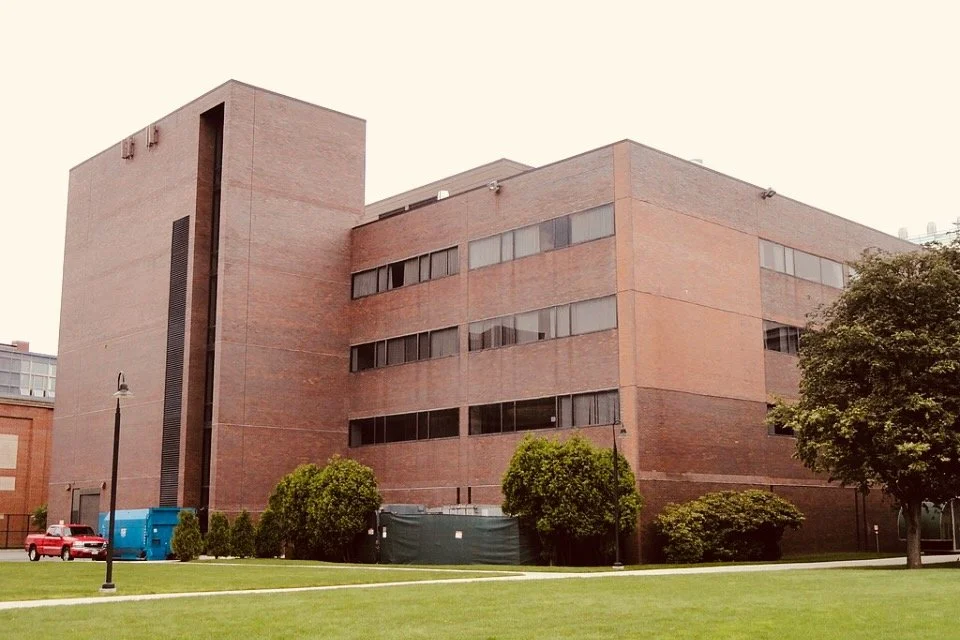
The 1970s era heating and cooling system worked about as well as this building’s aesthetics.
The Early Web
Simmons already had a domain and a rudimentary website. Starting in 1994, Deborah Smiley, then Chair of the Communications Department, had led the effort to establish a distributed model of web publishing. I first met Deb in 1995 when I took her Design for the Web class. I had already taught myself HTML and had done a few freelance projects, but this was my first opportunity to learn the craft in a structured way (this is also where I met Chris Miller; we would co-found Artefact Design, a web consultancy, the following year).
Influenced by pioneers like Muriel Cooper, who founded MIT’s Visual Language Workshop and later co-founded the MIT Media Lab, Deb could foresee how significant the web would become. Her plan required volunteers, people who were excited or curious enough to contribute their time and effort. It was different then—the early web was defined by an ethos of shared support and exploration and this seemed like a natural extension of that ethos. She encouraged (and at times cajoled) departments and offices to nominate a volunteer to learn HTML and then publish and maintain that page.
Despite some progress, the model didn’t take. Distributed ownership created a fractured website with gradually decaying pockets of effort across the institution. I was hired by Paul Colombo to help.
Paul was a middle school science teacher, at Simmons as part of the EnviroNet project, an NSF funded network started by Brewster Bartlett that connected K-12 teachers and students across the country to share datasets and curricula across such topics as BirdWatch, WhaleNet, and Roadkill. Paul was working on converting the original VMSVAX-based bulletin boards and email lists that Simmons provided to a proper website. With a Sun SPARC workstation under his desk, he coded EnviroNet in Tango, a new database-driven web development environment. He was even briefly interviewed on CNN about the project.
As Deb stepped away, the College convinced him to take on additional responsibilities, asking him to serve as a part-time webmaster. While the College saw that the site was now a thing, it didn’t yet consider it as a full-time job. Paul seemed like a natural choice because he understood the technology and inspired confidence in those around him. But, he wasn’t a designer. He understood right away that the web was about more than tech and that someone like me with both design and tech chops would be needed. This is when he managed to get a full-time role approved.
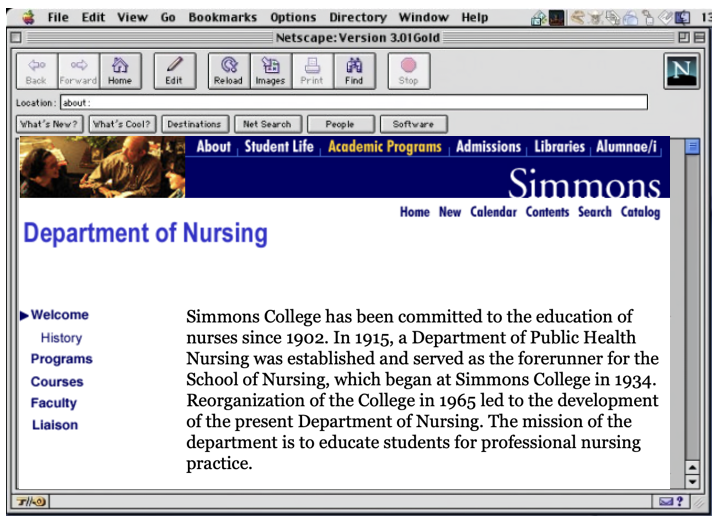
Today, web design is specialized, perhaps overly so. Back then, you did everything. I designed the graphics in Photoshop (back when “undo” only took you back one step), in the process establishing Simmons’ online visual identity, hand-coded the HTML (using table-based layout of course), walked around the College, picking up printed brochures to rewrite for the web and so on (I was particularly proud of the double-mouseover javascript I wrote). It doesn’t look like much now, but it was a very well-designed site for the time.
When I got done, I showed it to Paul. “It looks great, is it ready?” he asked. I told him it was ready when he was. His next question was whether we should ask someone. “Who would we ask, Paul? No one knows what we do.” He thought for a second and said, “good point, let’s go live.” That’s how that first website launched.
A Different Web Model
As the 1990s progressed, the College slowly came to understand the importance of the web. I had explicitly rejected a distributed web publishing model, which was unusual for universities at the time. Even as ‘webmaster’ became a common role, the default in the academy was to pull the web in a million different directions. Most institutions at the time let it happen. My instinct was it needed to be cohesive and coherent. I didn’t yet know about the term “human-centered design” (which didn’t become an ISO standard until 1999), but I’ve always loved design because there’s someone on the other end of the work who benefits. You owe your efforts to them. Letting the org chart dictate would be a defeat, both for Simmons and for the people who needed what the website could provide.
There’s a phrase I’ve adapted from my colleague Guy Felder: You always get what you deserve; deserving what you need may require change. In my case, to deserve the authority to centralize the web, it had to serve people both inside and outside the institution; it had to deliver quality you otherwise wouldn’t get from the default model; and it had to produce results, both to satisfy a complex array of constituents inside the College and to advance the mission of Simmons in the wider world. It wasn’t just about a nice looking or even nice-to-use website. It was all of the above.
Earning the Authority
Part of the answer was maximizing capacity, part was politics, and part was technology.
Capacity
On the capacity front, I hired and mentored web designers. Because you didn’t work in higher education for the money, I sought to give people ownership and autonomy over their work. Over time, I drew a small, highly talented group of people around me whose dedication yielded both good design and impressive productivity. At one point, I was challenged by a new manager about having such a small team, suggesting it was less risky to have lower-skilled, but more easily replaceable roles. I saw the logic, but also saw this was a fast track to mediocrity. This insistence offered some lessons in realpolitik. As Simmons approached its centennial, I saw Advancement under a new SVP grow to enormous size. When Simmons encountered financial difficulties, the SVP was able to “give back” some roles to balance the budget. She was the President’s hero. But, I’d rather have a small, great team than play that game. It did mean the onus was on me to retain the talent and to effectively communicate how much value the team was delivering.
One additional thing I insisted we do differently—one that may at first seem contrary to the capacity challenge—was for the team not only to design the site, but also to maintain it. I had to invent a rudimentary ticketing system to manage every request. In general, I saw this as making and keeping our promises. It also created a feedback loop where the team was incentivized to improve their work. After all, making and maintaining can reinforce one another (e.g., creating repeatable patterns, what we’d call a design system today, or using includes for reusable content patterns, what today is automatically handled by a CMS). I had heard of some who attempted a kind of in-house agency model, where offices would “hire” the in-house team, who would then hand back the completed work. This never made any sense to me. Without a feedback loop, there’s no potential for a flywheel effect.
Politics
If my tenure started with no one knowing what we did, that didn’t last long. The web exploded in popularity. People who hadn’t been interested in providing content for their pages (hence me gathering their print brochures and rewriting them for the web) suddenly had strong opinions about what their webpage should be. The interest was outstripping the capacity. I wrote policies and improved workflows. More significantly, I engaged with university leadership via the President’s Council, a group comprised of Deans and Vice Presidents. It took some convincing to win a recurring spot on their agenda, but once I was on the agenda, I had to balance a complex array of competing interests and make a case for sometimes hard decisions about where to spend limited resources. I think today, the answer would be easy: spend it on enrollment, on attracting new students, on growth. Certainly, we did this. But to our credit, it was a mission-driven conversation about not just what prospective students needed, but also what faculty and current students needed, what alumni should expect, and what students services and the libraries could be online. We thought about the web as a service that supported the full student lifecycle and the full purpose of the College. In the end, what mattered was establishing the political credibility to sustain a web model that was working.
Technology
Lastly, technology obviously mattered. If the creative talents of the team were at the core and the politics enabled a balanced deployment of resources across the university, then technology allowed us to know more and to act more effectively. Technology is always an amplifier of intent.
Before enterprise solutions had been invented (or were affordable to a small university), I created a number of workarounds. For example, every inquiry form submission on the website was copied to my webmaster@simmons.edu address. I created a sophisticated set of filters, rules, and groups in Microsoft’s email program Entourage (strangely, still one of the best email programs ever created for the Mac), allowing me to tag each inquiry by school, source, and follow-up state. The filtered data sets let me surface inquiry-rate trends per school, conversion patterns, and seasonal effects, and feed those back into how the College made enrollment decisions. It was an early form of marketing analytics, built before the marketing-automation category existed. I hacked Dreamweaver’s file check-in/check-out to act as a kind of version control software (I didn’t know the name, I just knew we needed something to do the job). This enabled us to scale access to publishing changes while maintaining control, so the design and code of the pages would adhere to visual and accessibility standards while enabling every office to make updates at will. Before email marketing software existing, I hand-coded HTML emails into Netscape, maintained a list on my computer, and ran scripts to ensure we respected unsubscribes.
Eventually, this era gave way to what we’d recognize as proper enterprise software. I led an initiative to adopt the College’s first enterprise CMS, increasing our project velocity by 3x. Later, I supported the implementation of Hobson’s, then the higher education standard CRM. I sought out and won a grant from the Davis Educational Foundation to fund the hire of the College’s first web developer, who helped us launch a student web portal serving Simmons’ 6,500 students. I look back and am thankful to have worked through a period without predefined solutions. I had to understand the problem before the technology. Frankly, technology is a lot less intimidating when you approach it from this angle.
Integrating Online Marketing
In 2001, I absorbed several employees into an online marketing function. Over the following decade the team expanded beyond digital design to include email marketing, in-house content marketing, in-house video production, and social media management, supporting nine major web properties across the institution. We were early adopters of web standards, accessibility, and mobile-first design.

By the time I left in 2013, the marketing website had earned a CASE Gold Award. The integrated digital strategy had contributed to 12% enrollment growth and to two capital campaigns ($50M and $85M, both exceeding their goal). I had created the digital engagement strategy for the Simmons Leadership Conference, which generated over $1 million annually for scholarships. The Universal Access Group's discipline had become the institution's accessibility culture, and the governance structure I had built to balance competing priorities across admissions, alumni, faculty, and students was a stable feature of how the College operated.

Throughout, we had remained a small, dedicated group of passionate practitioners. Members of my team went off to work for Adaptive Path, the UX consultancy that defined service design for a generation, and Viget, a leading UX consultancy in DC; helped build edX to deliver open education to learners across the globe; and created award-winning social media campaigns at Mullen Advertising.
Lessons
When Deb went on sabbatical in 1998, she suggested I take over teaching her courses. I spent 12 years teaching design part-time in the Communications Department on top of leading the digital and online marketing team until 2013. It helped me stay close to the people we were designing for: the students. That was a pattern consistent throughout my time at Simmons. Many jobs abstract away who they’re for. People are segmented into ever smaller boxes or assigned steps in a workflow that’s blind to the larger “so what?” I was lucky to work at a time when there were no rules, when you had to understand the whole to solve one of the parts. I also had the right instincts. At the beginning, I saw design as for someone and viscerally felt a responsibility to solve hard problems so a good thing could find its way into their hands. I often think the question ‘what do you love doing’ is misplaced. There are always things you have to address first—policy, workflow, politics, technology—you didn't necessarily want to do. But you're happy to solve them because it clears the way for the thing that matters. The design of a beautiful, intuitive, and useful website is really about enabling progress in someone else's life.

The last design I led at Simmons included a comprehensive update to the information architecture and design system to engage prospective students, support current students and faculty, and connect with alums. This effort was paired with ongoing content and email marketing along with CRM integration.


Hero photo by Brian Talbot
Role
Online Strategy
Design, Information Architecture, Creative Direction, and HTML/CSS Production
Digital Marketing Lead
Key Achievements
Unified Online Brand
Early to Go Mobile
Early Adoption of Web Standards
Established Accessibility Team
Established Email Marketing
Established Social Media Strategy
Established Content Marketing Strategy
Developed Web Services Master Plan
Adopted College's First CMS
CRM Implementation