Insightfil
Insightfil was a health-care initiative from Artaic, a mosaic tile manufacturer, whose goal was to revolutionize the experience of using prescription pills. While it may initially seem odd for a mosaic manufacturer to make the leap to health care, when you consider that the core of their expertise is custom software development and robotics manufacturing, it begins to make more sense. The same robots and software that create beautiful mosaics by placing thousands of tiny tiles are also ideally suited to placing pills in a custom pill pack.
A robotics startup redefined mid-engagement as a patient-adherence service · Two go-to-market pivots · A patient journey map the CTO said transformed how the organization understood its own purpose
What Insightfil Thought It Was Building
Insightfil started as a robotics-and-packaging company looking for a market. By the end of the engagement, it had become something different altogether: a patient-adherence service that used robotics and packaging as instruments to help patients live better lives.
The visible pivots along the way, from central-fill pharmacies to consumers, from pharmaceuticals to nutraceuticals, were not surprising pivots. It’s the kind of thing most startups experience. The strategic shift underneath them, however, ran deeper. What kind of company should Insightfil be? What problem was it actually trying to solve? And most importantly, who was their customer and why should they adopt the solution?
The First Strategy: A Robotics Startup
When I started working with Insightfil, the go-to-market strategy was business-to-business. The vision centered around a robot that could fill customizable pill packs, a tedious and exacting process prone to human error. By reducing fulfillment errors at the pharmacy and dosage and timing errors for the patient, Insightfil hoped to offer a compelling reason for central-fill pharmacies to invest in its technology.
Design research, then, focused first on central-fill pharmacies to observe and interview pharmacists and pharmacy techs to understand the context where the robot would operate and the workflow it had to optimize. I also visited nursing homes to understand how medications were actually distributed and where Insightfil's approach might make a difference. That’s the first time I learned the term “nurses’ thumb.”
Initially, the team ran with the core market assumption that central-fill pharmacies would adopt a workstation that demonstrably reduced errors and improved throughput. As such, we put most of the early design energy into the workstation itself. The work was as much about proving out the metrics that would matter to a pharmacy buyer as it was about the experience of using the workstation. Without measurable improvements in error rates and packets-per-hour, the UI wouldn't carry the sale on its own.
I prototyped the UI/UX in Keynote, sized and oriented to display on the vertical Dell monitor that would sit on the production workstation, and we paired that prototype with a full-scale physical mock-up of the workstation itself. Testers—pharmacy techs working through a realistic batch—used both the mock software and the physical workflow at the same time. That setup let us iterate on two things at once. First, to asses the workstation as a physical object and tool for producing pill packs. And second, to pressure test the working assumptions about how the backend would handle reporting and workflow optimization on a busy floor.
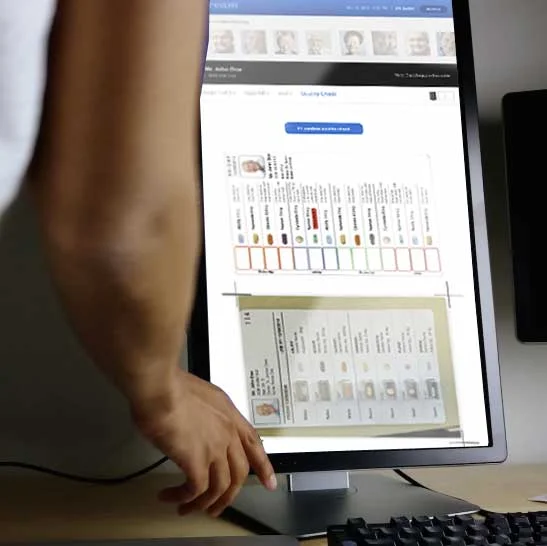
The workstation prototype
A lot of the most useful changes came from the physical side. We watched testers stage pills, adjust to the height and angle of the screen, and walk back and forth between the workstation and the shelves. Each of those revealed something about how the software would have to behave to keep up with the pace of the floor. As that happened, the design of the software evolved in interesting directions. It intelligently batched orders so a tech could gather medication for several patients in one trip, cutting down on the back-and-forth between workstation and shelves that we'd seen eat into a shift's productivity. The reporting layer evolved alongside the workflow, surfacing the kinds of metrics a pharmacy manager would want for staffing and capacity decisions on top of the error and throughput numbers that would prove out the system itself.
The Market Pivot
While that work was underway, the team learned that central-fill pharmacies had limited incentive to differentiate their offerings, and the regulatory bar for introducing a new pharmaceutical packaging format was higher than initially understood. The original target customer was going to be too costly and difficult to reach. As a result, we pivoted from B2B to consumers, from pharmaceuticals to nutraceuticals, the category of high-quality supplements that integrative medicine prescribes alongside conventional treatment.
We got in the car and visited pharmacy-grade nutraceuticals manufacturers, learning about their offerings, challenges, and potential openings for a novel solution. We also visited the Sloan-Kettering integrative cancer center at Hartford Hospital, where nutraceuticals like Bromelain (derived from Pineapples) were under investigation as a long-term pain relief treatment. A core patient challenge came into focus: adherence. According to the World Health Organization, improving adherence even marginally was the equivalent of discovering a blockbuster drug. The problem of adherence was just as relevant to high-quality neutraceuticals (particularly when managed in a clinical context) as it was to pharmaceuticals. And the regulatory bar was significantly lower.
The Reframe
At this point, we could make a strong case that a new package design, filled by robots, would reduce medical errors. But these would have no effect on whether a patient took their supplements as scheduled. The design problem was fundamentally different. Rather than a technical workflow to speed throughput while reducing errors, this was a behavior change design problem.
With that reframing, we drew on two behavior-science frameworks: COM-B (Capability, Opportunity, Motivation), and Self-Determination Theory (Autonomy, Competence, Relatedness). Both gave us a sharper set of questions than “does the patient remember.” Instead, we asked: Could they physically use the package? Were the supplements on hand at the right moments? Did they feel the regimen was theirs or imposed on them? And did they believe it was working?
I baked these into a patient journeymap created to synthesize our research. As the team stood around a large printout of the map on a table, the conversation started to naturally focus on the things that would matter most to the patient. By pairing the map with the behavioral frameworks, we started to use it as a diagnostic tool. Where might adherence be supported or eroded? Where in the end-to-end design can we shift behavior and what shape should the design take to achieve it?
The Patient Journey Map
The journey map changed how Insightfil thought about its own purpose. Each step the patient took could be examined alongside the next, and the team could see together which moments most affected whether a patient stayed on regimen. Prioritization became a different kind of conversation, focused less on which features of the workstation to ship first and more on where in the patient journey would positively affect adherence. The map surfaced four high-leverage moments: initial engagement, the first clinical visit, the first order, and the experience of opening the package at home. We prototyped the touchpoints for each of these high-value moments to assess the end-to-end experience and its impact on the lives of patients.
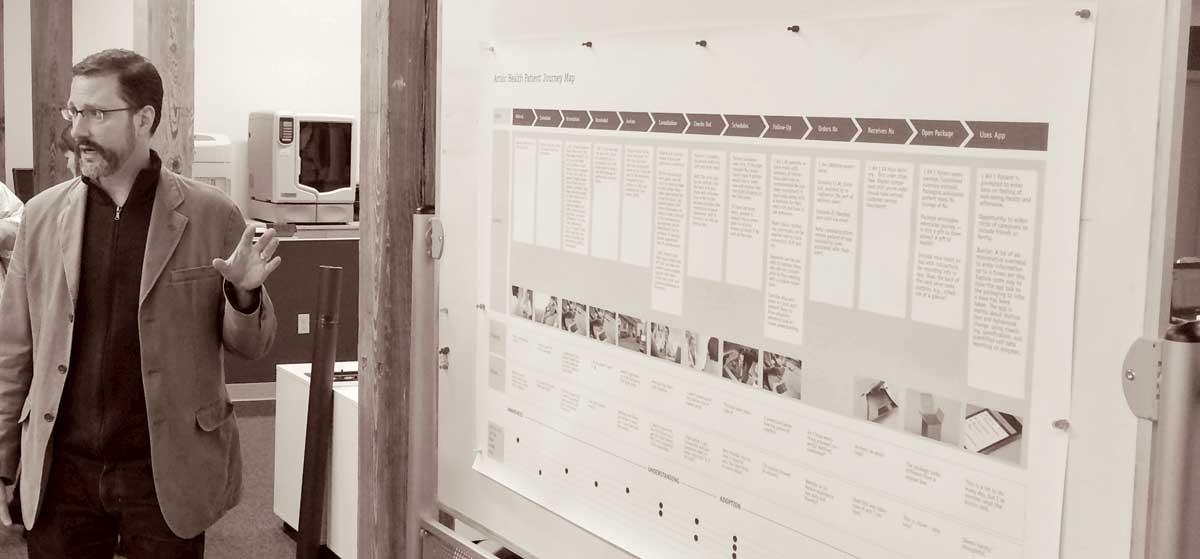
Presenting the patient journey map at a Boston Design Museum sponsored event.
What Insightfil Became
By the end of the engagement, Insightfil had effectively redefined itself. The robotics business with a fulfillment workstation as its product had become a patient-adherence service that used robotics and packaging as instruments for changing patient behavior. The market pivot had opened the door to that redefinition, while the journey map was the artifact that made it visible and operationally relevant inside the company.
Mike Trachtman, Insightfil's CTO, later said the patient journey map transformed how the organization understood its purpose, and that it continued to shape design and technology prioritization beyond our engagement.
The Takeaway
The strategic shift at Insightfil, from a technical solution to a patient-centered service, came from sitting with the problem long enough to see it differently. It required going out to where patients actually were, and letting the picture of what the company should be take shape over time. The process is generative. It requires depth and patience that startups under pressure tend to shortchange.
Human-centered design offers real benefits to any organization, but perhaps to startups most of all. They're the ones searching for an offering that someone will actually need enough to switch to. They're also under the most pressure to move fast, which makes the slower work the first thing to get cut. I find myself wondering about what gets lost when a team can reach for AI to produce an authoritative-sounding answer without anyone actually spending time with the people the offering is meant to serve.
Role
Strategist
Designer
PM
Key Deliverables
Brand Expression
User Research
Customer Journey Map
Workstation UI/UX
Mobile App Design