CSU East Bay
CSU East Bay's continuing education unit knew it needed to invest. Like many institutions in 2014, they assumed the investment was technology: an enterprise CRM and a refreshed website. The risk was that they would buy the technology and miss the problem the technology was supposed to solve.

700% inquiries (Year 1) · 168% inquiries (Year 2) · 128% enrollment growth · UPCEA Silver Award
“The project was transformative. The entire student experience and communication process blends seamlessly. The result is a big home run.”
Avoiding the Technology-First Trap
CSU East Bay had already selected Salesforce and migrated their registration experience to PeopleSoft. The website was the next purchase on the list. I co-led the strategy and research to test the assumption that had brought them to the project, led the design of the new student experience that emerged from it, and collaborated with the team's technical partners on the CRM, CMS, and shopping-cart work that brought it to life.
The Core Question
Discovery began with one question: what was CSU East Bay actually trying to do? I interviewed and surveyed every staff member in the continuing education department, plus faculty, college administrators, and students. With students, we mapped the experience they wanted continuing education to deliver. What surfaced was not a technology problem.
The unit's identity, market position, and content had remained static while the institution's offerings had grown. The brand no longer reflected the value on offer, and a prospective student found little reason to choose CSU East Bay over regional competitors. The website's structure had been built from the institution's perspective, not the student's. And the recent PeopleSoft migration had introduced a 48-hour delay between account creation and the ability to register for a course, producing a 37% drop in completed registrations.
The unit described itself as student-centered, but the processes and incentives that would make student-centeredness real were absent. In staff and faculty's working assumption, the student experience began at the application step—not at the moment a prospect first encountered the brand.
Inserting a CRM into that situation would have substituted automation for student experience.
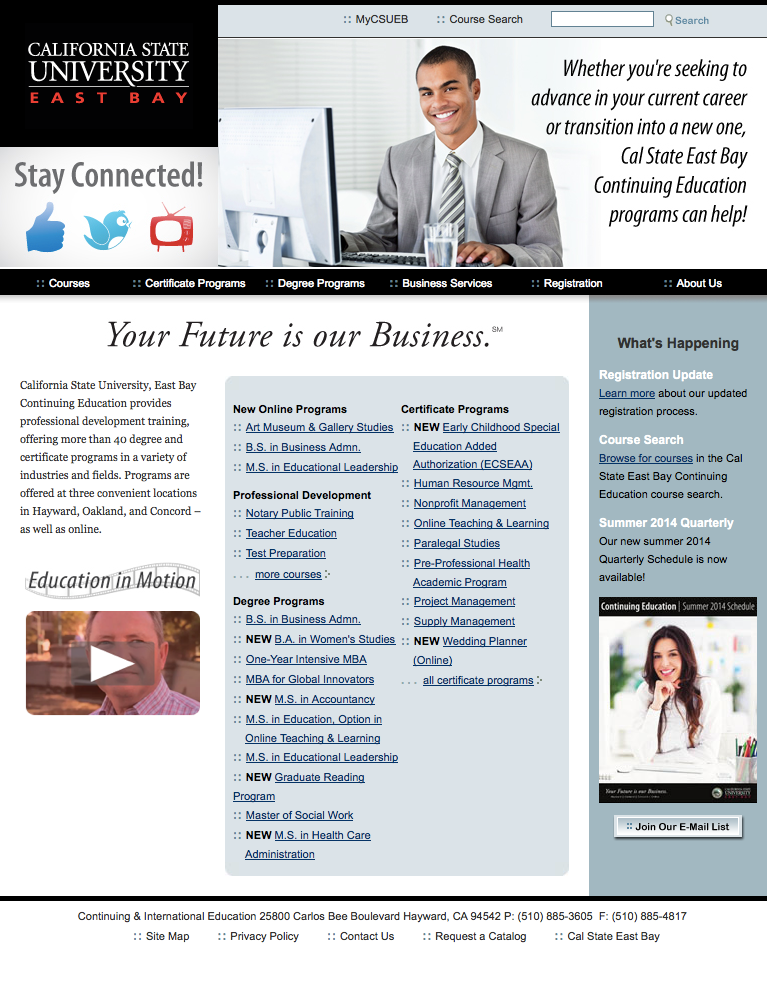
The existing CSU East Bay website.

Detail view of a service blueprint showing the "as is" info session experience, highlighting failure points and periods of excessive wait time.
It’s Not a Technology, But an Ecosystem
What I recommended was not a website, or a CRM, or a registration fix pursued in isolation. It was a brand, marketing, and recruiting ecosystem: a working model of how every part of the unit either kept the brand promise or broke it. The website, the registration cart, the person who answered the phone, the location of the classroom, each was a touchpoint that either reinforced the student's reason to enroll or undercut it. The CRM, the website, and the registration system would still be built. But they would be built around a student experience strategy, not around the org chart or the default assumptions baked into a technology platform.
The Work
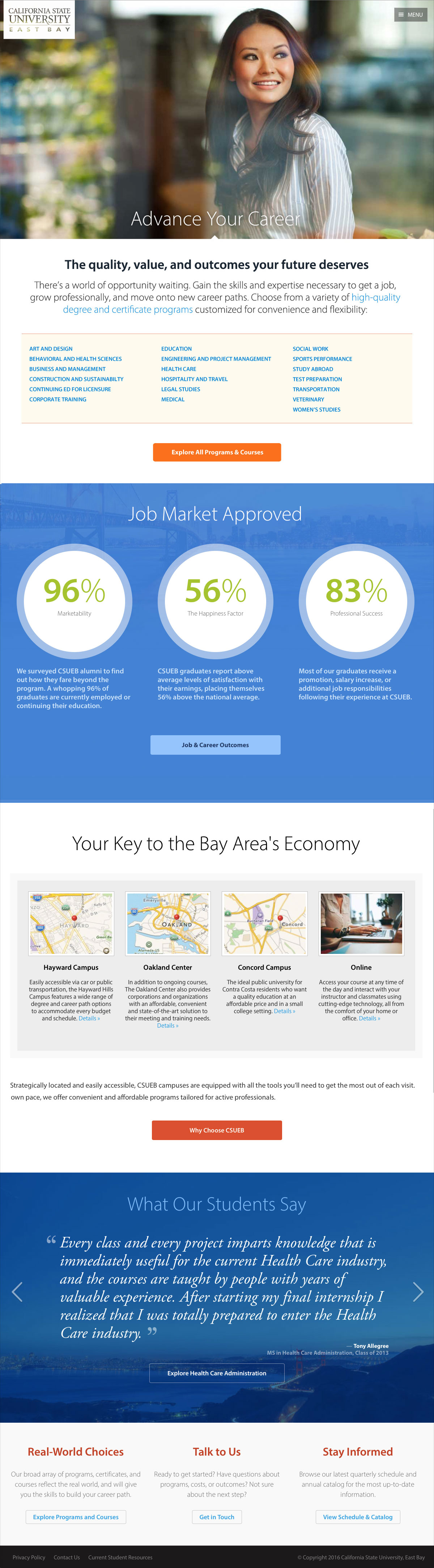
I led the design of the new student experience end to end. The brand, market positioning, content strategy, and the messaging and information architecture all came together in a new design for a mobile-first website (built on the existing Cascade CMS to preserve IT support), and a custom shopping-cart UX layered on top of PeopleSoft (designed to eliminate the 48-hour barrier without requiring any change to the back-end system).
I collaborated with the team's technical partners on Salesforce implementation, helping to define the recruiting methodology, the recruitment funnel, and the communication plans so the CRM would do the work the strategy needed rather than the work the platform happened to support. The same collaboration applied to the CMS configuration and the shopping cart integration with PeopleSoft.

CSU East Bay's new site is mobile-first.
Results
Year-one inquiries from the website increased 700%. Year-two inquiries grew an additional 168%. Enrollment in the continuing education unit grew 128%. The new shopping-cart UX reversed the registration decline the PeopleSoft migration had caused. UPCEA recognized the website with a Silver Award. And CSU East Bay renewed the engagement each year, with total contract value approaching seven figures.
Operationally, the unit moved from a reactive posture to a proactive, data-informed one: they were able to track prospects through the funnel, align marketing campaigns with strategic goals, and forecast against pipeline rather than against past performance.
The Takeaway
Buying a technology before understanding the experience it’s meant to deliver is costly. Indeed, you pay twice, first for the platform and again to recover from a technology-first implementation. The critical step is to define the desired student experience—the promise you will make and keep—no matter which technology supports it.
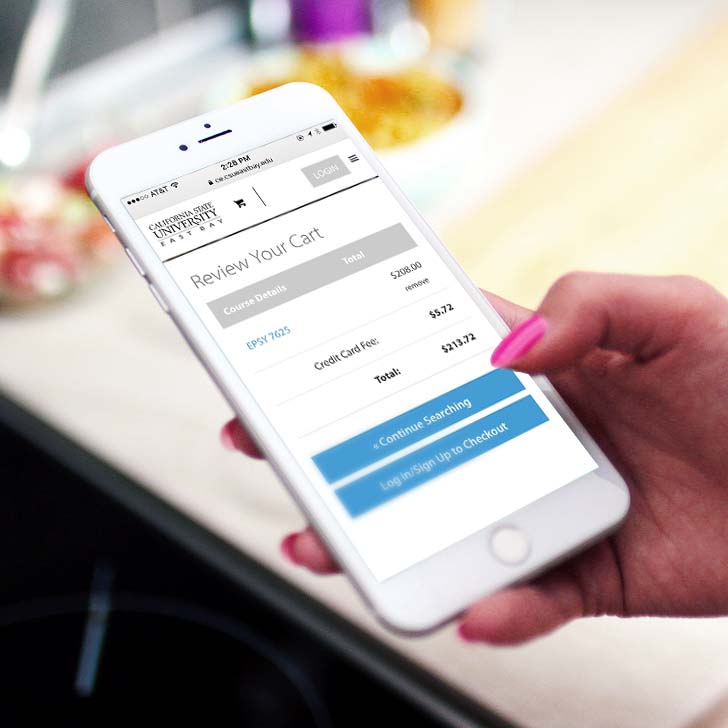
I designed a custom shopping cart UX/UI that presents a friendly face; our technical team did an amazing job getting it to talk seamlessly to Peoplesoft.
Role
Strategist
Researcher
Designer
Key Deliverables
Strategy Report
User Research
Web Design
Service Blueprint
Marketing Email Templates
Print Collateral
Information Architecture
Training and Support