Blue Cross Blue Shield of Massachusetts
I led the service-design project that transformed BCBSMA's plan to engage consumers in reimagining healthcare and, in the process, transformed BCBSMA itself. The work unwound well-intentioned, but incorrect decisions at every layer, from the consumer's mental model up through brand, space, staffing, and governance, and rebuilt both the frontstage consumers would encounter and the backstage BCBSMA had to become to deliver it. The launch produced a fivefold increase in visitor traffic and more than a thousand co-creative conversations with consumers.

5x increase in visitor traffic · 1,000+ co-creative conversations with consumers · Selected over IDEO and Continuum · Basis of my Service Design Week keynote, "Design-Led Change: Service Design, Innovation, and Storytelling" (Chicago, 2019)
“Cantina took the concept of prototyping to a whole new level when they created a full-scale model of our new space. This allowed us to engage senior leadership in a meaningful ‘show don’t tell’ conversation which dramatically changed the course of the design in favor of a more positive consumer experience.”
Two Stories
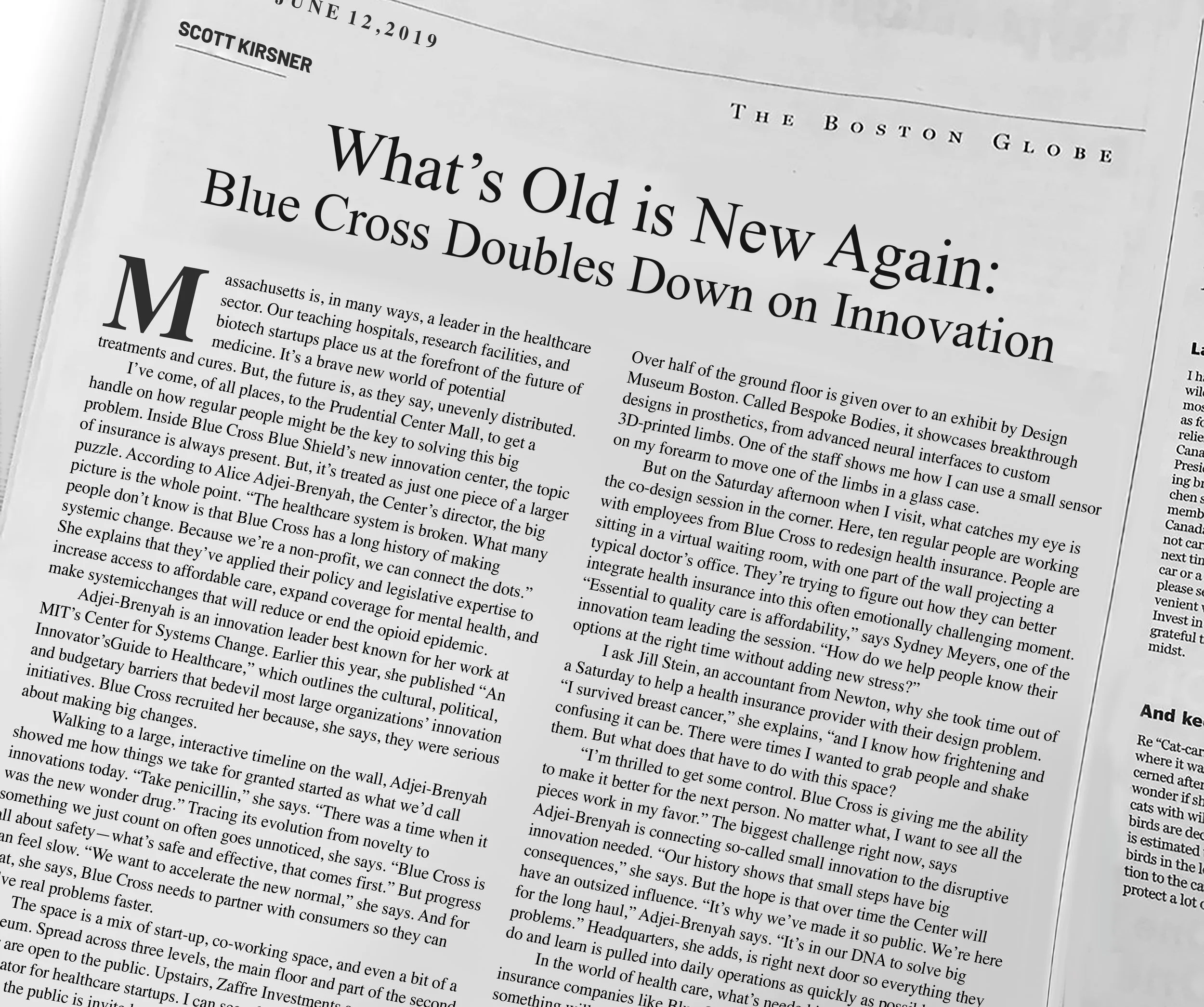
Two articles by Scott Kirsner appeared on the desk of Blue Cross Blue Shield of Massachusetts's CMO. Both were from the future. One described what would happen if the company launched its planned innovation center the way it had originally been designed. The other described what would happen if BCBSMA took our advice and rebuilt the center—and itself—around what consumers actually wanted from a healthcare innovation conversation. The CMO read both, turned to the executive team, and said: “I know which version I want to wake up reading.”
Of course, neither article had actually been published. Kirsner, a long-time Boston Globe innovation columnist and later founder of Innovation Leader, had not visited the center because the center did not yet exist.
The articles had been written on a tight deadline in Kirsner's voice and printed to look like real Globe clippings. They distilled months of research, insights, and recommendations into two readable futures the executive team could choose between. Arising from a conversation with the CSO, I suggested the idea. I split the writing with a colleague, Cantina's then Chief Innovation Officer, George White. I wrote the version in which BCBSMA took the advice. George wrote the version in which the original plan went unchanged.
The decision the executive team made that day was not between two recommendations. It was between two stories the public would tell about the center—and by extension, about BCBSMA—once the story was no longer theirs to control.
The Origin
BCBSMA has a long history as a catalyst for change in U.S. health care. Their study Roadmap to Coverage helped shape the Massachusetts health insurance reform that became RomneyCare and, later, the model for the Affordable Care Act. As a chartered public charity, BCBSMA sees its responsibility to its members expansively, encompassing the shape of the broader healthcare system itself.
The innovation center was CEO Andrew Dreyfus’ bet that the company could push their purpose further. In his framing, innovation required clarity about where and why the system needed to change, and the most direct way to develop that clarity was to put the company in conversation with real people in a place intentionally designed for it.
However, the premise depended on two conditions BCBSMA had not yet fully understood: the work would have to be designed around and with consumers rather than at them, and BCBSMA itself would have to commit to the innovation center as something more than an experiment off to the side.
I led the service-design engagement that, in a colleague's framing, replaced an initial plan of doing everything different and expecting this tiny initiative to pull the larger organization in its wake with one in which BCBSMA and the innovation center moved together. The work surfaced that the original plan was based on an incorrect set of assumptions—from the consumer's mental model up through brand, space, experience, staffing, training, and measurement—and unwound those decisions in sequence so the redesign could be rebuilt from the consumer outward. Both sides of the experience had to be redesigned at once: the frontstage consumers would encounter, and the backstage BCBSMA had to become to deliver it.

We worked together with the client to conduct field research to better understand consumer healthcare needs and challenges.
Research
I led the research and strategy in partnership with George and my colleague Krista Siniscarco, which included observational and intercept interviews with prospective visitors, co-design sessions with everyday consumers, one-on-one interviews with virtually every member of the BCBSMA executive team, and field research, bodystorming, and co-working sessions with BCBSMA staff. What surfaced was a stack of challenges. Every choice the original plan was built on started from an assumption our research had shown to be incorrect.
At the deepest layer was the consumer mental model. People had no schema for “a health insurer running a public innovation experience.” The word innovation itself was confusing—most associated it with technology, and a design-savvy subset associated it with “innovation theatre.” At its base, the foundational assumption about the consumer’s needs, wants, and desires made every choice above it problematic.
The brand assumption was incorrect because consumer trust would not be earned by hiding the source behind an unknown sub-brand. The space design was incorrect because it had been designed for a visitor BCBSMA had imagined, not the visitor who would actually come. The exhibit experience was incorrect because it assumed interest that was not yet there. The staffing model was incorrect because it had been designed around transaction rather than conversation. The training was incorrect because it prepared staff for an encounter that wasn't going to happen. The metrics were incorrect because they would measure activity rather than the change in trust or understanding the center was supposed to produce.
We had to unwind those decisions one-by-one, not because they were poorly made, but because each had been made on top of a deeper assumption the research had now contradicted. Until they were unwound, the redesign could only paper over the original plan rather than improve it. Moreover, because our work had now made the cost of the original plan's assumptions visible, this also opened a conversation around a larger organizational commitment to the center and what it could mean to BCBSMA itself. The opportunity expanded from consumer experience to organizational transformation.

Participatory design with consumers allowed us to bring to the surface unmet needs and desires by having people make objects and tell stories about what they mean and why they matter. Designing with—not just for—consumers was a critical ingredient for designing a successful experience.
The Two Pivotal Artifacts
Two artifacts broke the executive team's impasse.
The first was a full-scale prototype. Over three days, we built a 1:1 foam-core model of the space and walked BCBSMA's executives through the experience. Standing inside the proposed space, leadership made strategic choices they had been deferring on paper. The mock-up turned abstract design decisions into something they could experience directly. In the words of the Director of Innovation, it “changed the course of the design in favor of a more positive consumer experience.”
The second was the pair of mock Globe articles. Once the center launched, BCBSMA would not control the story. Rather, Boston's media—and through them, the public—would put it into their own words. People would visit, curious about this public space. Would the center have a clear purpose? A story people told others? An impact worth embracing? In sum, why would everyday people tell you that the center was essential?
Each did different but complementary things. The foam-core prototype revealed assumptions embedded in the overall experience and helped executives make decisions about the design itself. The articles helped executives viscerally feel the consequences of the choices they were making, choices that could not be controlled once out in the world of public memory.

The full-scale prototype of the space was made out of foam core in three days. It helped to streamline decisions and optimize the design of the space. It also allowed the client’s staff to rehearse and refine the service experience prior to opening.

We “bodystormed” (like brainstorming, but based on playacting) the service design with the client to rapidly move from idea to mature service design with the client’s staff. The full-scale prototype of the space proved invaluable for this exercise and helped to accelerate design decisions.
The Redesign: Frontstage
With buy-in from the executive team, and working closely with the client, the brand agency, and the architecture firm, we changed the name, identity system, and interior design of the space. We rebuilt the strategic narrative from “distinct innovation experience from an unknown entity” to “a public expression of BCBSMA's mission as a chartered public charity.”
Future-state journey maps visualized how to entice, engage, and re-engage visitors across multiple visits. Service blueprints documented what would have to happen backstage—which teams, at which moments, with which handoffs—to make the frontstage experience hold together. These were practical, operational guides. They specified staffing responsibilities, handoffs, and the conditions under which the experience would actually hold together day to day.

A client staff team member talks with a consumer about the latest innovations in prosthetics.
The Redesign: Backstage
The center could not meet its full potential without changing BCBSMA. I co-led the design of the operational infrastructure that change required:
A revised staffing model and a training program that prepared staff for conversation rather than transaction.
A curatorial plan that gave the team a way to choose which exhibits and programs belonged in the center over time.
Governance and a decision-support tool that let the team make real-time choices the experience design implied.
Measurement designed for the change the center was meant to produce, not just the activity it would generate.
Two further initiatives connected the center to BCBSMA as a whole.
The first was an internal employee video in which BCBSMA's CEO, CMO, and CSO each appeared alongside frontline staff, talking clearly about why the center mattered to the organization, what it was for, and what each of them was committing to make it work. The video was not external marketing, but rather internal commitment, recorded in a form employees could see, share, and refer back to.
The second was a recommendation that every BCBSMA employee, regardless of role, cycle through the center to spend time talking with consumers directly. The reasoning was straightforward: a health insurer is, at base, an organization in service of people whose interaction with health care is largely invisible to the company's own employees. The center could be the visible counterpart. Bringing every employee into direct, unfiltered conversation with consumers turned the center from a public-facing exhibit into an instrument of cultural change inside BCBSMA.

Results
The center launched with Bespoke Bodies, an exhibit on innovative prosthetics from Design Museum Boston. Hospital in the Home, a follow-on exhibit on delivering clinical care in patients' residences, drove a fivefold increase in visitor traffic. More than a thousand co-creative conversations with consumers yielded direct insight into what people actually wanted from healthcare innovation, and what they still didn't trust about the system.
That level of engagement was exactly what BCBSMA had set as the goal. It was possible because the design extended beyond what visitors saw and felt into how the organization was structured, measured, and equipped to show up for them.
Frontstage Impact: Fivefold increase in visitor traffic · 1,000+ consumer co-creation conversations · Redesigned brand identity, spatial experience, and visitor journey
Backstage Impact: Revised staffing model · Staff training program · Governance and curatorial plan · Decision-support tool · Internal employee commitment video · Employee rotation through the center
The Takeaway
A tiny initiative cannot pull the larger organization in its wake. Neither can a top-down decree. Both presume the organization will embark on a bold direction without actually making the choices necessary for it to happen.
BCBSMA's original plan was an attempt to honor the CEO's vision “safely.” As originally envisioned, it was a public innovation experience designed to operate beside the company, not inside it, and involved a level of commitment that asked little of BCBSMA itself. Starting with the consumer, the work showed why every decision had to ladder up to a deeper commitment, until what initially might have felt like the brave decision was instead the obvious and necessary one.
Starting from the inside and working out might produce an innovation center that raises passing intrigue, perhaps a photo shared on social media. But it won’t earn a second visit, a comment to a friend, or the trust that a health insurer trying to change the system needs from the public. What we built wasn’t just an engaging experience. It was also an instrument of systemic progress.
Frontstage Impact
Fivefold increase in visitor traffic
1,000+ consumer co-creation conversations
Redesigned brand identity, spatial experience, and visitor journey
Backstage Impact
Revised staffing model
Staff training program
Governance & curatorial plan • Decision-support tool
Role
Strategist
Researcher
Service Designer
Key Deliverables
Insights & Recommendations
Customer Journeys
Service Blueprint
Full-Scale Service Prototype
Print & Digital Design
Revised staffing model
Staff training program
Governance & curatorial plan
Decision-support tool