SES
SES is one of the world's leading satellite owners and operators with over 70 satellites in both geostationary and medium Earth orbits. They offer high performance video and data solutions virtually everywhere on the planet. Their services help broadcasters to reach more viewers on screen, mobile network operators to connect uncharted markets, peacekeepers to receive real-time intelligence, and passengers to work and play online no matter where they are.

The Challenge
Our client at SES, the head of global product design and engineering, saw something that wasn't obvious from inside the company's strong financial position. The future of satellites was going to be contested by companies like SpaceX (which at the time hadn’t yet launched anything). He foresaw that they would compete on the customer experience as much as on the satellite itself.
SES was technically excellent and aware of it. They were comfortable. But his view was that technical excellence wasn't going to be sufficient on its own. He came to us because he wanted to start building the customer experience capability SES would need before it was urgently needed.
He saw customer centricity as the way to drive service innovation and growth, and he was looking for both the insight and the operating capability to make that real inside SES. But he was running into silos and needed help creating leverage to drive transformation forward.
Discovery
My team and I began with primary customer research, interviewing customers throughout the globe across SES's segments—broadcast, aero, cruise, mobility, and government—to understand their unmet needs, their experience with SES, and how they thought about the value of the relationship. In parallel, we worked inside SES to understand how the organization was structured around customers, where handoffs broke down, and where allies for change already existed. The global head of CX, an early advocate of service design, became one of those allies and gave the work additional internal leverage.
From the research, we built customer journey maps and used them in a prioritization workshop with SES leadership. Onboarding emerged as the area where customer pain and organizational opportunity overlapped most clearly. We agreed to focus there: a redesign that would matter to customers immediately, and a piece of work that would prove out the underlying methodology and build internal momentum for change at scale. In the words of the global head of CX, this is how we could help SES “stop mopping with the taps open” when it came to intentionally delivering a great customer experience.


Design Enablement
In the second phase of the work, the goal was to make the practice live inside the company beyond our engagement. We moved into design enablement, pairing our team with SES product, sales, and customer success teams as they took customer insights and applied them to the the design of new offerings. The intent was to build SES's internal design capability so that translating insight into action could happen without an outside consultant in the room.
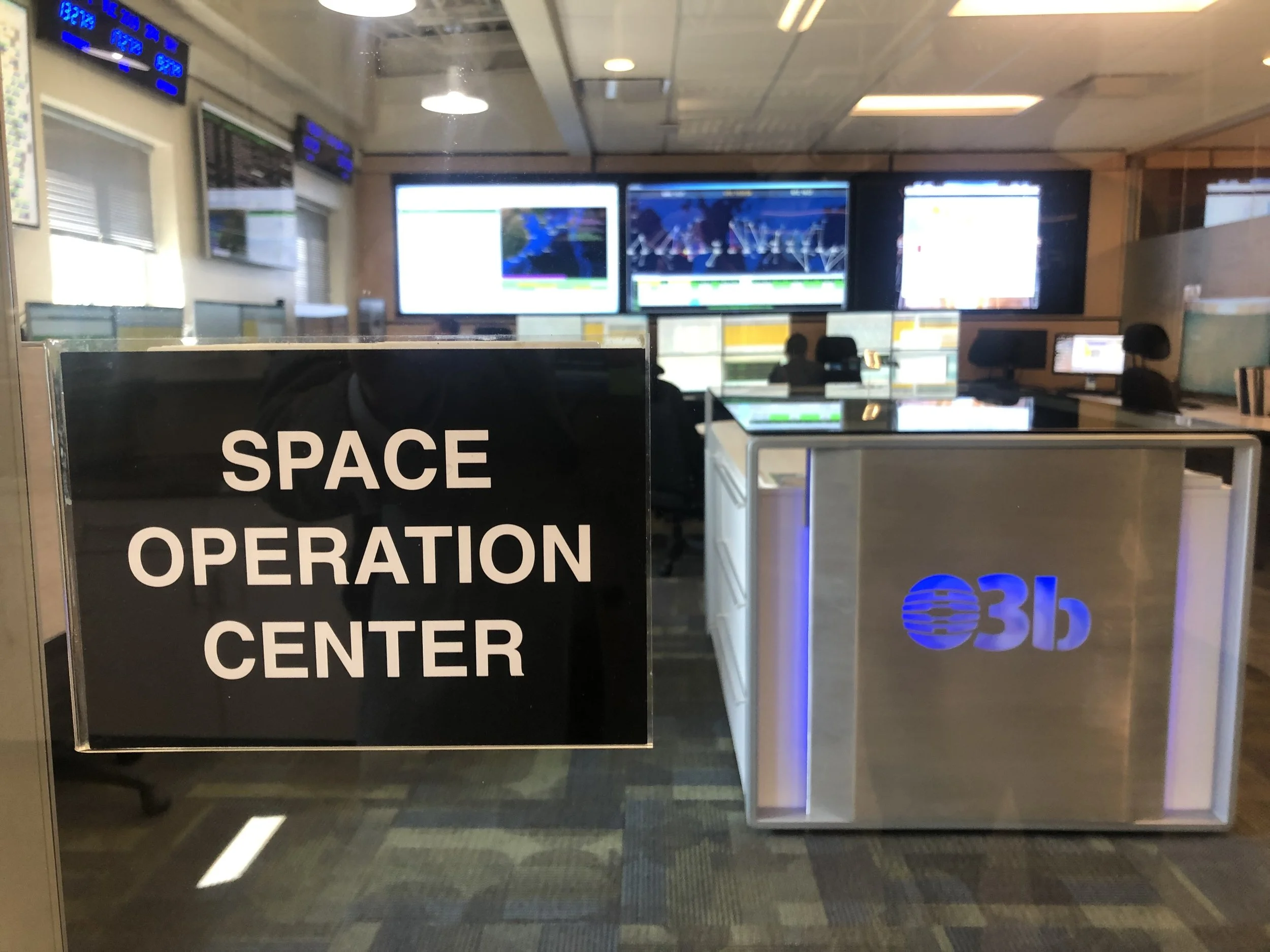
The clearest application of this work was the SKALA Global Platform, SES's next-generation ground system for delivering managed broadband services across their multi-orbit fleet, the O3b MEO constellation and SES's widebeam and high-throughput GEO satellites. We worked with the SKALA team to take what discovery had surfaced and turn it into a coherent customer narrative for the platform, one that could align product, sales, and customer success around the same understanding of what SKALA was for and who it benefited most. To distill the SKALA story, I applied a five-part strategic narrative framework popularized by Andy Raskin:
Name the Enemy
Why Now
Show the Promised Land
Outline Barriers, and
Provide Evidence It's For Real.
Surprisingly perhaps, story is one of the more reliable ways to make sense of a technical product, both internally and externally. The framework gave the SKALA team a shared spine for talking about the product: what problem it was solving, why the timing mattered, what the customer's experience would look like inside the relationship, what would have to be true to get there, and what proof points already existed.
Once the cross-functional teams could answer those five questions for the customer in the same way, the conversations about SKALA shifted from a purely technical, inside-out perspective to an outside-in customer experience perspective.
Outcomes
The onboarding redesign moved SES from a transactional handoff model toward a relationship-based account model and reduced silos across the customer-facing functions involved. The medium Earth orbit product, originally positioned around capability, was repositioned around the use cases customers actually had. The SKALA narrative gave the team a shared story for taking a new product to market and a way to keep cross-functional teams aligned around the customer as it matured.
We continued our work with SES afterward, helping them assess and improve their UX maturity and integrate that capability into a critical product launch. Our client was promoted to Vice President of Innovation, the role that would own the revised customer experience strategy. I helped write the job description.
The Takeaway
Changing an organization the size of SES is like turning a supertanker. The ship turns miles ahead of the rudder, and only after the captain has been steering toward the turn for a long time. The challenge in this kind of engagement is how to make progress without falling prey to “boiling the ocean.”
Our answer was to pick one focused area—customer onboarding—and use the relationships we built doing that work to extend the same approach into product launches like SKALA. Each piece was a small turn of the rudder, and the cumulative effect was a company that had begun moving in a different direction by the time the competitive pressure that our client had anticipated actually arrived.

Frontstage Impact
Redesigned customer onboarding experience
Shift from transactional to relationship-based account model
Backstage Impact
Silo reduction across customer-facing teams
Repositioning of new MEO product for customer relevance
UX maturity assessment integrated into product launch
Client promoted to VP as a result of the engagement
Wrote the job description for a new VP of Innovation role to own the revised strategy
Role
Strategist
Researcher
Service Designer
Key Deliverables
Strategic Recommendations
Customer Journeys
VP Job Description